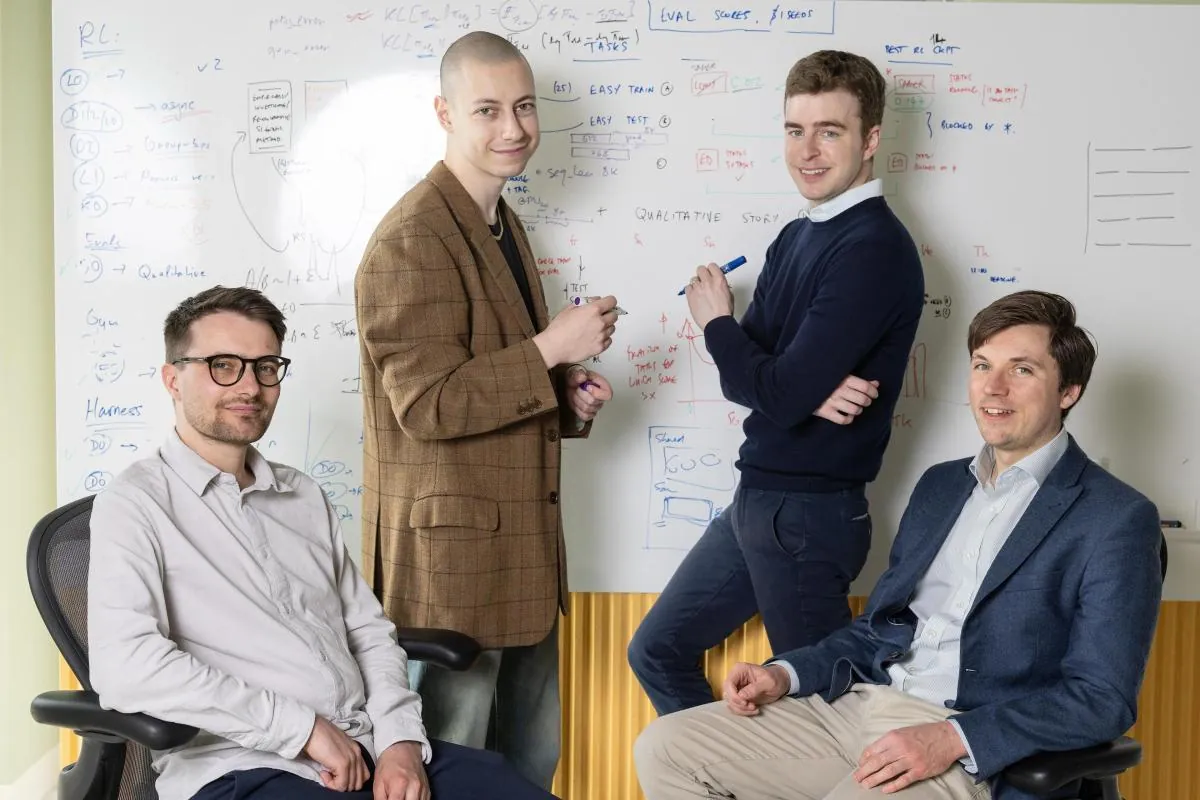
DeepMind alumni's Inherent says its 27B-parameter Faraday beat Claude Opus 4.8 and GPT-5.5 at replicating papers
London lab Inherent, founded by Google DeepMind alumni including Louis Kirsch and chief scientist Edward Hughes, says Faraday — an agent built on the 27-billion-parameter Qwen 3.6 and trained with outcome-based reinforcement learning — scored above Anthropic's Claude Opus 4.8 and OpenAI's GPT-5.5 at reproducing published paper findings without being given the results. The claim is unaudited and the task is narrow, but a $50M-seed team hitting frontier-scale results on a 27B model points to training method, not parameter count, as the lever on agentic science work.
Source: techcrunch.com ↗
What was most interesting to us about this was not so much the result of beating those frontier agents — which of course we liked — but was actually the way we went about building this.
Why this matters
- → 27B model beats frontier-scale systems at scientific replication—training method outweighs parameter count
- → Reinforcement learning for "research taste" suggests a scalable path to agentic science discovery
- → DeepMind alumni startup moving from stealth to concrete results in weeks, signaling execution speed