Eight AI coding agents drive a robot fleet to 99% dexterous task success — two of three still fail in the physical world
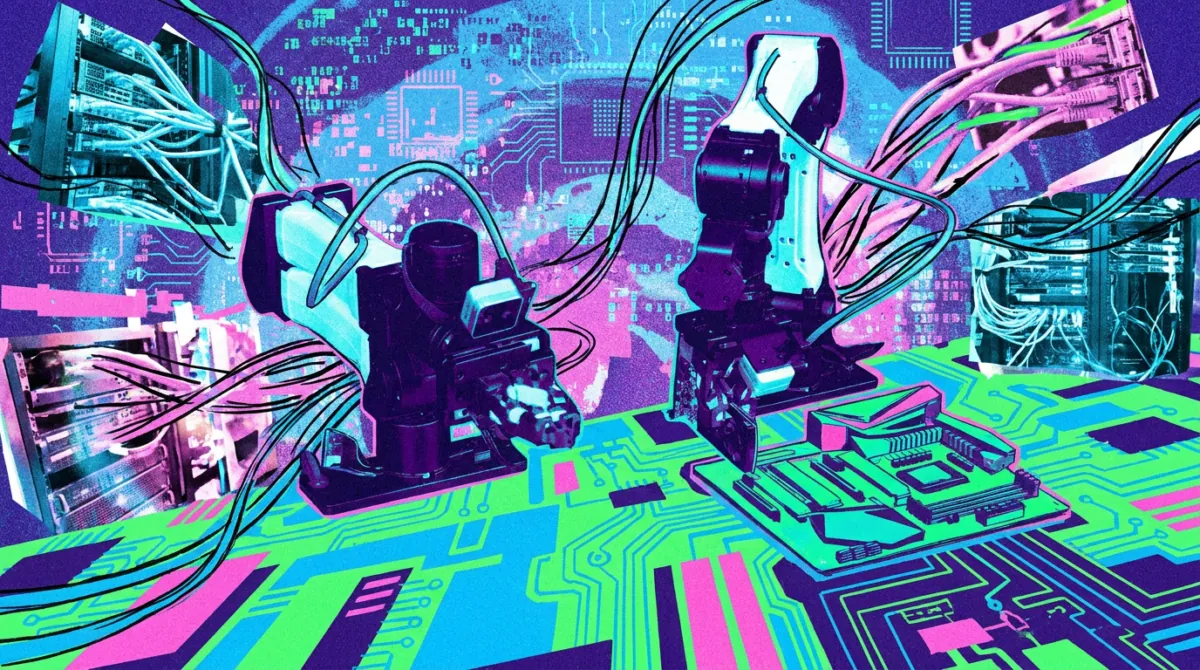
Nvidia, CMU, and UC Berkeley's ENPIRE system pairs each dual-arm robot station with its own coding agent, which writes reward functions, reads research papers, and shares successful training recipes through Git — cutting Push-T training time from five hours (one agent) to two hours (eight agents), with pin insertion dropping from 90 to 40 minutes, and reaching up to 99% task success. The hard limit is unchanged: all three agents tested — Codex/GPT-5.5, Claude Code/Opus 4.7, and Kimi Code/Kimi K2.6 — solved tasks in simulation, but two of three failed in the physical environment, making sim-to-real transfer the binding constraint on autonomous robot learning.
Source: the-decoder.com ↗
On the Push-T test, all three agents solved the task in simulation, but two out of three failed in the real environment.
Why this matters
- → Robots now self-improve through AI agents without constant human intervention, dramatically cutting training t
- → Sim-to-real gap remains unsolved: two of three agents failed in physical world despite simulation success.
- → Fleet coordination via Git enables knowledge sharing across multiple robots, compounding learning gains.