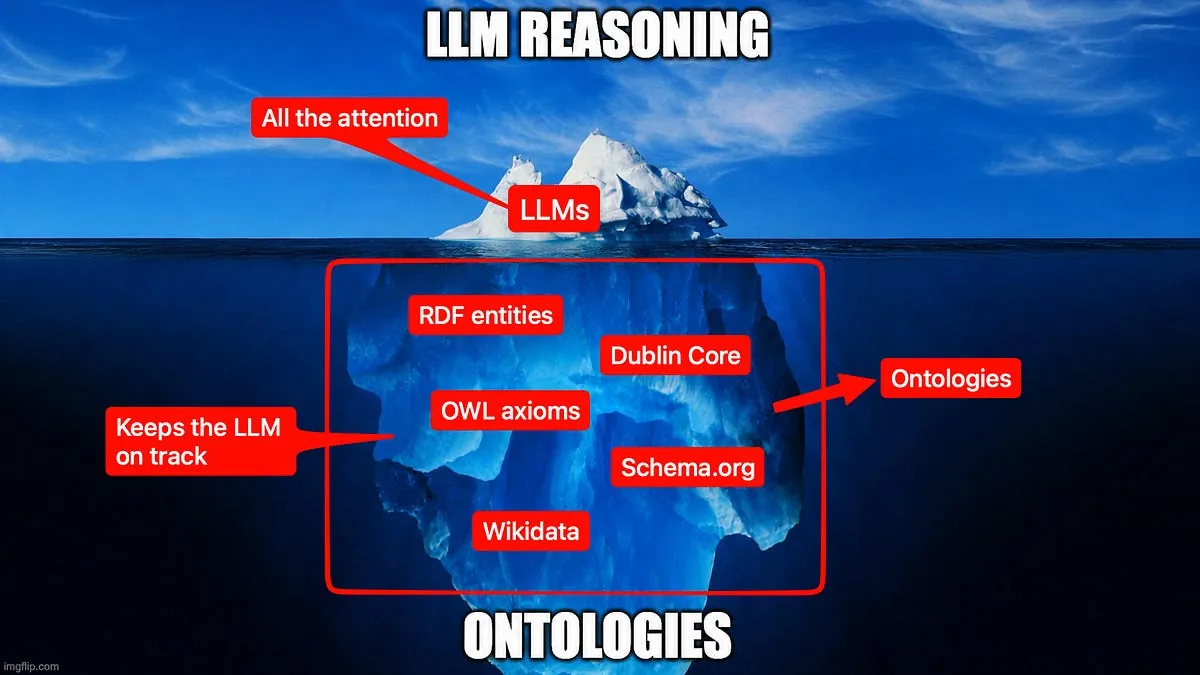
Ontologies return as guardrails for AI agents
At the AI Engineer World's Fair, UC Berkeley's Frank Coyle argued that agentic systems need ontologies — formal models of classes, properties, and relationships — as logical guardrails on probabilistic LLMs, and Neo4j CEO Emil Eifrem laid out a three-layer version for enterprise agents: business concepts, technical metadata, and runtime execution traces. The buildable point is that existing vocabularies — schema.org, FOAF, Dublin Core, plus RDFS and OWL — are in model training data, so a developer can prompt for them and run an OWL reasoner over an agent loop instead of inventing a schema. The old maintenance problem that sank the 1990s Semantic Web remains unsolved, though Prasenjit Sarkar suggests agents that update their own ontologies when they hit edge cases change its character.
Source: latent.space ↗
an OWL axiom is a rule a machine enforces.
Why this matters
- → Ontologies provide deterministic guardrails for probabilistic LLM agents, preventing costly hallucinations and
- → Established web vocabularies (Schema.org, FOAF, Dublin Core) already exist in LLM training data, eliminating r
- → Neurosymbolic AI bridges language expressiveness with computable structure, enabling thinner, more maintainabl