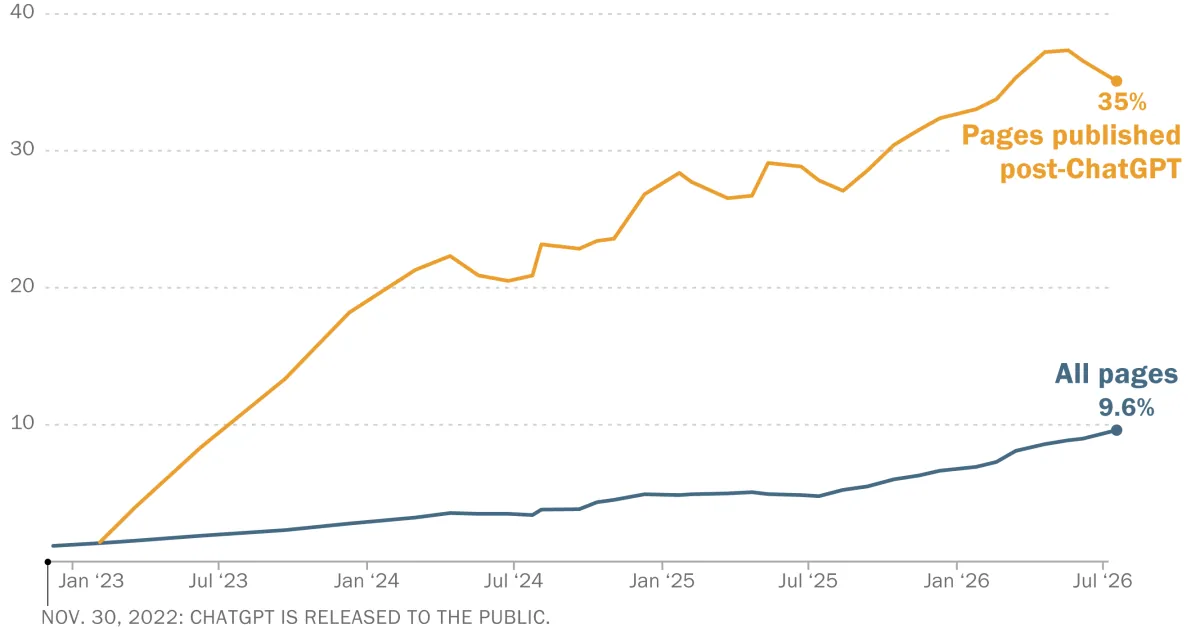
Pew: 10% of English webpages show signs of AI authorship, a third of post-ChatGPT pages
Pew ran almost half a million English-language webpages from Common Crawl through the Open Pangram detector and found signs of AI authorship in 10% of a 10,000-page July 2026 sample, rising above one-third among pages published after ChatGPT's late-2022 release. The split is commercial: roughly 10% of .com pages qualify against 4.6% of .org and about 1% each of .edu and .gov, so the synthetic share is climbing fastest on the commercial web while institutional domains stay close to human-written. The style tells moved with it — em dashes roughly doubled since 2023, Oxford commas rose 63%, and AI-favored words such as "delve" more than doubled.
Source: pewresearch.org ↗
In the July 2026 snapshot, signs of AI authorship can be found in over one-third of pages published after ChatGPT was released.
Why this matters
- → One-third of post-ChatGPT pages show AI authorship signals; commercial web adoption is 10x institutional.
- → Detectable style shifts (em dashes, Oxford commas, AI vocabulary) are doubling/tripling across the web.
- → Authenticity and trust gaps widen as AI-authored content becomes the majority of newly published pages.