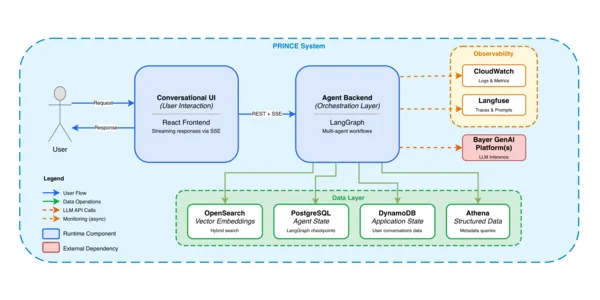
PRINCE, Bayer's production multi-agent RAG system, draws the line between context engineering and harness engineering
Bayer AG and Thoughtworks published a full case study of PRINCE, a LangGraph-orchestrated multi-agent system that routes pharmaceutical researchers' queries through Researcher, Reflection, and Writer agents using RAG over scanned PDFs and Text-to-SQL over structured metadata. The article's most portable takeaway is the split between context engineering — shaping what each agent receives — and harness engineering — orchestration, retry, fallback, and observability around the models — a framework a developer can carry directly into any production agentic build.
Source: martinfowler.com ↗
By combining the generative power of LLMs with the precision of information retrieval systems, Retrieval-Augmented Generation (RAG) has emerged as a promising technique.
Why this matters
- → Splits agentic AI design into portable, reusable patterns (context vs. harness engineering).
- → Demonstrates production-grade multi-agent RAG handling decades of unstructured pharmaceutical data.
- → Establishes framework for reliability, observability, and human control in complex LLM systems.