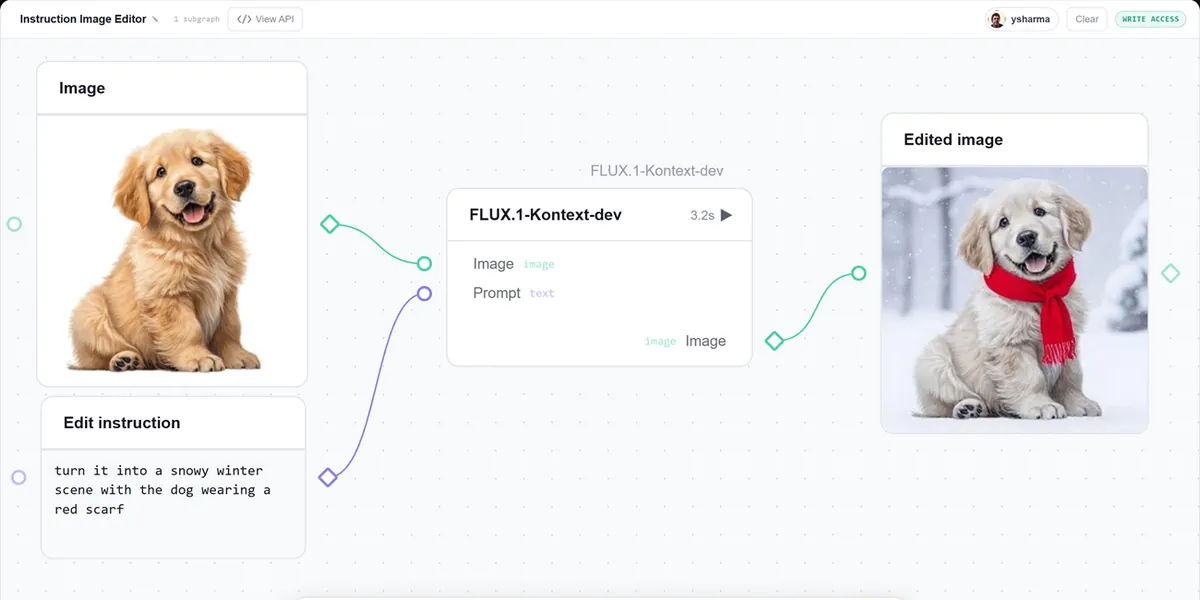
Gradio's gr.Workflow turns a pipeline graph into both a visual canvas and a REST API
Yuvraj Sharma and Abubakar Abid introduced gr.Workflow, a Gradio primitive where an AI pipeline is declared as a graph of typed nodes and that one definition serves a drag-and-drop canvas plus a REST endpoint per output. A developer can chain FLUX, Qwen-Image-Edit, another Space, or a local GPU model behind @spaces.GPU into a single graph, call named endpoints like /sticker or /voiceover from the Gradio client or curl, and deploy to Hugging Face Spaces in one command.
Source: huggingface.co ↗
You describe your steps as a graph of typed nodes, and Gradio serves a drag-and-drop canvas where every node is runnable and every intermediate result is visible.
Gradio documentation
Why this matters
- → One pipeline definition becomes both a visual UI and production REST API.
- → Enables parallel fan-out patterns, local GPUs, and external model chaining in one graph.
- → Deploy to production Spaces with a single command—no boilerplate.
Pipeline as interface